Promising Export Opportunities
Egyptian Exports Indicators
Exports play a central role in the Egyptian economy, serving as a crucial source of foreign currency and a key driver to bolster the competitiveness of the national economy. Egypt adopts a comprehensive strategy to boost the competitiveness of Egyptian products and access new markets, particularly in the context of global challenges like geopolitical tensions and market instability. This strategy also prioritizes green transformation, digitization, and active participation of the private sector in formulating implementation policies.
USD 43.9 Billion
Total exports in FY 2025/26
USD 37.6 Billion
Total commodity exports in FY 2025/26
USD 100 Billion
Target exports by 2030
Egypt’s Top Export Markets and Commodity Exports
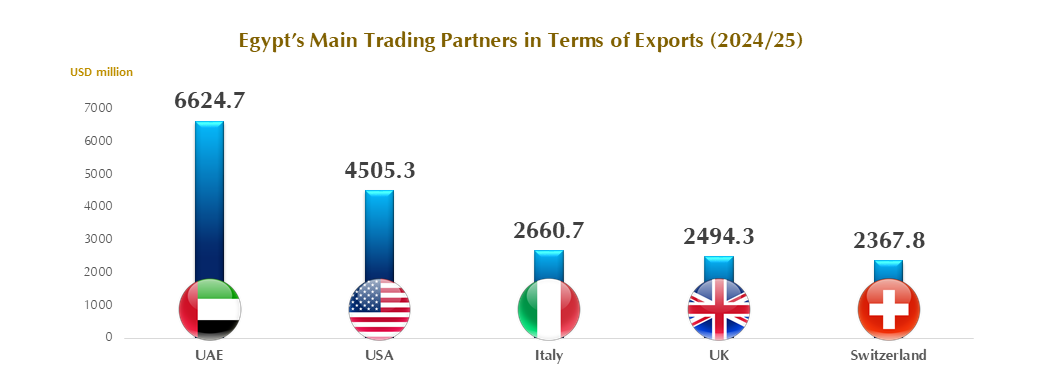
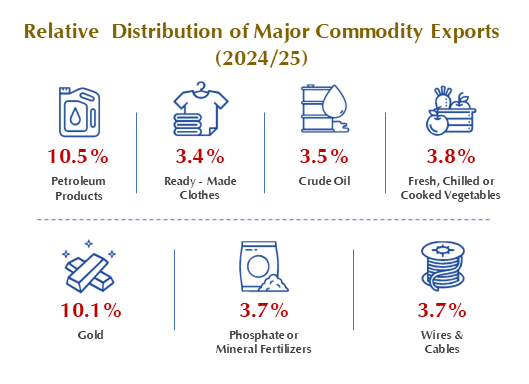
In FY 2024/25, the United Arab Emirates, USA, Italy, UK, and Switzerland ranked among the leading destinations for Egyptian exports. The sectors driving this export growth included petroleum products, gold, fresh chilled, or cooked vegetables, phosphate or mineral fertilizers, and wires & cables.
Source: CBE
Egypt's Efforts to Promote Exports
Egypt`s primary objective is to shift towards an export-driven economic growth model, based on the diverse productive components within the Egyptian economy, through offering financial and regulatory incentives, developing the logistics infrastructure, and opening new markets via international trade agreements, and strengthening economic relations with global partners.
1.Export Promotion Initiatives and Strategies
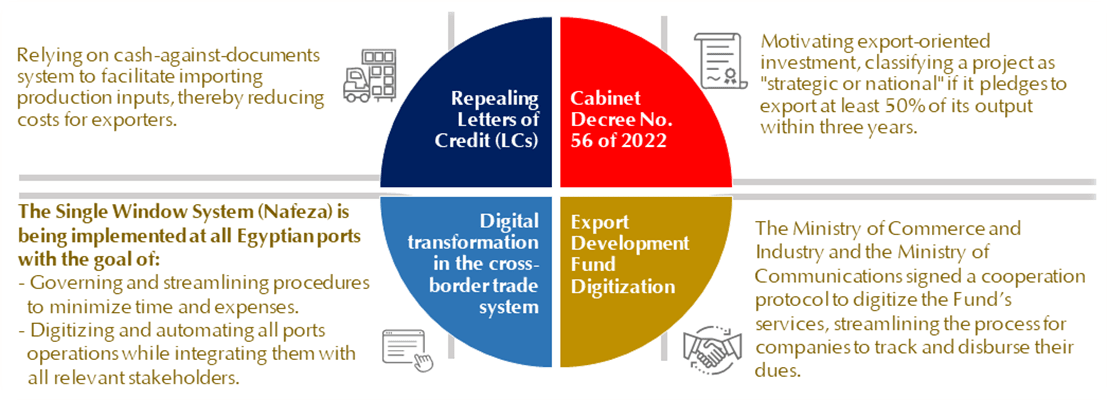
The government exerts significant efforts to boost and promote Egyptian exports by implementing various strategies and programs designed to eliminate obstacles to Egyptian exports, as outlined below:

Supreme Council for Exports
The Council was restructured in 2023 to promote Egyptian exports, increase their volume, and align industrial and commercial policies to achieve global competitiveness.

African Exports Development
The strategy aims to boost exports to Africa to USD 10 billion by 2025, leveraging AfCFTA, enhancing logistics, eliminating tariffs, and simplifying shipping processes.

Export Burden Rebate
Aims to boost the value and diversity of Egyptian exports by supporting growth sectors, reducing exporter burdens, offering incentives, and investing in infrastructure.

FEDA
Egypt joined The Fund for Export Development in Africa to boost export of goods and services, boost Intra-African trade, support SMEs, and attract investments.

EgyEx Triple 10 Strategy
The strategy aims to increase exports by 20% annually, reaching USD 145 billion by 2030, through 10 export zones, 10 industrial clusters, and targeting 10 key markets.

Export-IT Program
A flagship program of ITIDA, aiming to boost Egyptian IT-enabled services (ITES), support companies in resource development, and enhance competitiveness.

Foreign Trade Portal
Launching the Foreign Trade Procedures Portal with United Nations Conference on Trade and Development to streamline trade,enhance transparency and boost competitiveness
2.Export Support
The government is implementing numerous measures to achieve export support, assist local businesses, and motivate them to expand into global markets. This support comes in multiple forms, including direct financial aid, tax incentives, and streamlining logistics services, all aimed at boosting the competitiveness of Egyptian exports and expanding their share in global trade.
3.Expansion into Foreign Markets
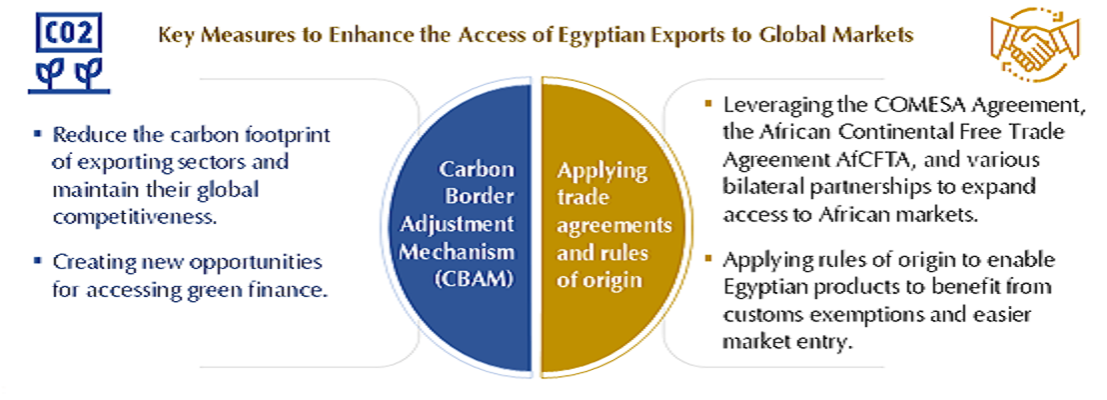
Egypt maintains a wide network of free and preferential trade agreements with global and regional partners, enhancing export market access (Trade Agreements). The state is also adopting the Carbon Border Adjustment Mechanism (CBAM) to reduce export-related carbon emissions and sustain global competitiveness.
Source: Cabinet - CAPMAS
4.Establishing and Developing Free and Industrial Zones to Boost Exports
Egypt possesses nine public free zones equipped with the essential utilities and infrastructure to launch and operate projects. These zones are linked to ports and roads to reduce transportation costs, aiming to attract export-oriented investments and increase the added value of Egyptian products. Free zones contribute approximately 20% of total Egyptian exports.
Currently, efforts are underway to expand the free zones due to increasing investor demand. Land has been allocated for four new free zones in Borg El Arab, 10th of Ramadan, 6th of October, and New Alamein. Additionally, three free zones are currently under construction: Damietta Furniture City , Aswan, and Nuweiba.